-
- Nov 22 2026
-
Kimberly Van Landingham

- 0
Leadership Skills: Developing Executive Presence
Some people are looked up to, asked for their opinion, and followed. Yes, they are smart and have good ideas, but there is more to it. It isn’t a single trait you are either born with or without, it’s your Executive Presence. Executive presence is the critical bridge between being good at your job and being trusted to lead an organization.
It’s a sophisticated mix of psychology, communication skills, behaviour, and strategy.
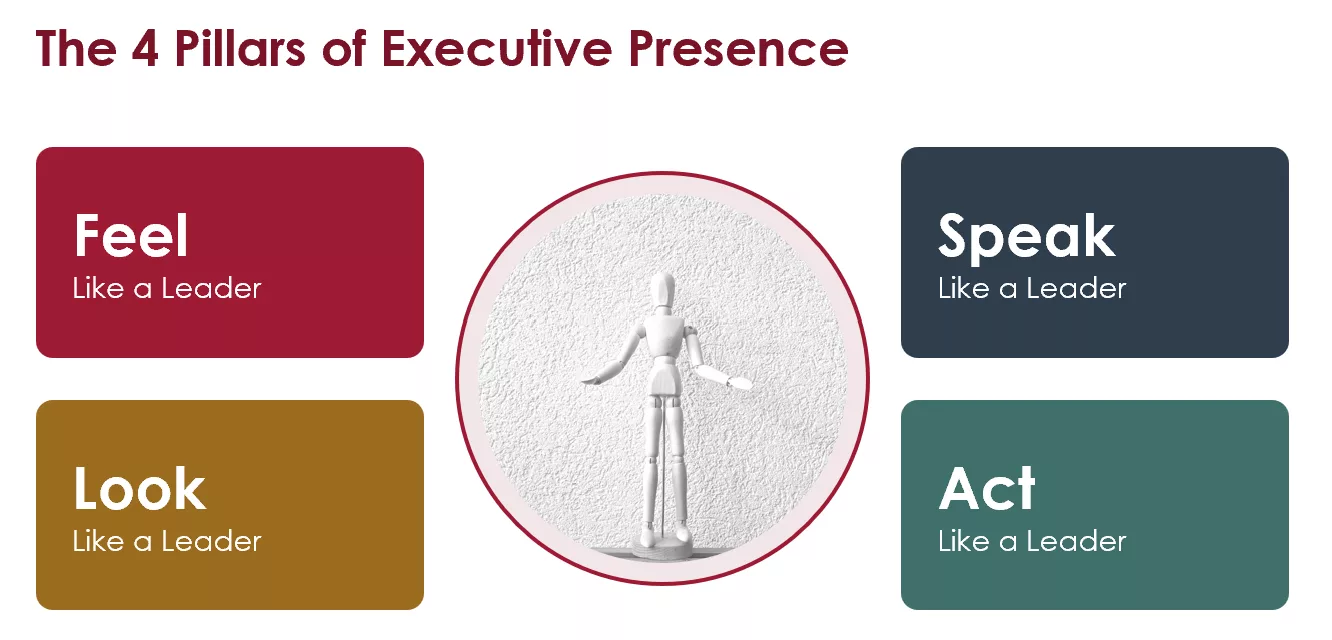
Based on research, 20 years of corporate experience, and 15 years training executives; I’ve developed a simple model with four pillars to describe the concept:
- Feel like a leader,
- Speak like a leader,
- Look like a leader, and
- Act like a leader
Executive Presence 1. — Feel Like a Leader
To feel like a leader, one must become a master at managing his or her mind and body. Faced with long hours, difficult employees, and stressful business situations; one must remain calm, look confident, and make expert decisions at every moment. To accomplish this, effective leaders are acutely aware of —
-
- Their physical needs – When the body is weak from lack of decent food, exercise, or sleep, the mind and body underperform. One may look weak and make poor decisions. Becoming aware of these needs and developing strategies to address them is key. Often, leaders use personal trainers and establish routines to address these needs.
- Their body’s reaction to stress – Let’s face it, business is stressful. Speaking to a journalist or to the board can easily cause a stress reaction. When it occurs, the body responds – hormones release causing our heart rate and breathing to increase, digestion slows and our mind becomes cloudy.
Fortunately, tools, models, and exercises can help one manage these reactions. Even those with imposter syndrome can learn to manage these negative automatic reactions, replacing them with confidence and better decision making. - Their default emotions – No one likes an unstable reactive leader — not their employees, not the board, and not the stock market. Yet, everyone feels anger, impatience, and jealousy. Leaders know their triggers and how to manage these emotions, so they maintain composure.
Everyone is different. Genetics, brain chemistry, life experiences, and culture shape our physical needs, stress reactions, and emotions.
Leaders with executive presence know themselves. They monitor and manage their thoughts, focus, and physical reactions showing the world confidence, stability, and their humanity.
Feeling like a leader is key for one to lead from the inside out.
Executive Presence 2 — Speak Like a Leader
Leaders speak in a way that people listen. They know how to think strategically about their communication, then they speak with clear and concise phrases, and memorable key messages. Great leaders motivate, persuade, and steer their organizations by mastering their voice and using storytelling. Most importantly, great leaders are also great listeners.
One may think that leaders are born with these skills, but most have taken courses or had private trainers. For example, Barak Obama wasn’t born a great speaker. He struggled with a college rally speech in 1981 and froze during a fundraising pitch at age 25. [1]
Speaking like a leader is critical to communicate your direction to your team.
Executive Presence 3 — Look Like a Leader
From posture and body language to clothing preparation and style, a leader sets the standard for the organization’s definition of professional appearance. The strength shown as one enters a room, makes eye contact, smiles, and uses stable gestures (without jitters) shows certainty and stability.
Of course, expectations for body language are different in different countries and industries. In Brazil or Italy, gestures are a critical part of communications. While in Russia or the German part of Switzerland, the body is still when talking as movement distracts from the words. Yet, executive presence adjusts and is both, flexible and authentic.
Executive Presence 4 — Act Like a Leader
Executive presence includes actions that are ethical, dependable, and without bias. Leaders listen, empathize, and model ideal trusting behaviour. This includes delegating, managing conflicts, and participating in social events. Always looking out for those above, below, and outside the company; leaders are not afraid to disagree and choose unpopular decisions when it is the right thing to do.
While some traits are inherited, executive presence is built on learned values, habits, and skills.
Your Executive Presence
So, how do we develop our executive presence? Being the perfect leader is difficult, and being a perfect global leader is harder still: executive presence in the USA is different than in Japan or Switzerland. However, you can use this framework to build your own personal executive presence.
First, use the 4 Pillars to determine your picture of an ideal leader. Use my explanations as a starting point but challenge them and decide for yourself how to (1) feel like a leader, (2) speak like a leader, (3) look like a leader and (4) act like a leader.
Second, using this structure and your definition, identify your current executive presence, your strengths, and your opportunities for improvement. Then, with your authentic self in mind, work to become the leader that you want to be. 😊
Author:
 Kimberly VanLandingham is the CEO, lead trainer, and strategist for European Market Link Sàrl, including Presentation Training Switzerland. Helping international business leaders, B2B sales, and technical teams; she facilitates live workshops and private training courses in public speaking, media training, and leadership. Kimberly has over 20 years of corporate experience at the DuPont company, degrees in engineering and communications, and over 14 years training professionals and leaders.
References:
- J. Stillman, (Apr 15, 2025.) INC.com, “President Obama Just Explained the 5 Changes That Transformed Him from a Terrible Communicator into an Excellent One”. Taken on 22 Nov. 2026 from https://www.inc.com/jessica-stillman/barack-obama-how-i-learned-to-be-a-great-communicator/91173178